
Environmental awareness for students is the understanding of how natural ecosystems function, how human actions disturb those systems, and what each person can do to safeguard the planet for coming generations. It is not limited to memorizing facts about pollution or recycling. It shapes how young people make everyday decisions, choose careers, and participate in their communities.
Despite its importance, a significant gap separates what students need to learn from what schools actually teach. A UNESCO analysis of 100 national curriculum frameworks revealed that nearly half (47%) do not reference climate disruption at all, and 70% of young people surveyed were unable to explain it clearly. These numbers make a strong case for treating ecological education as a priority, not an afterthought.
This guide explains the importance of environmental awareness, outlines the core topics every learner should study, and provides actionable strategies that students, teachers, and parents can put into practice right away.
Table of Contents

Key Takeaways at a Glance
- Nearly half of all national curricula worldwide still omit climate education entirely.
- 80% of people globally support teaching environmental topics in schools.
- The renewable energy sector alone now sustains over 16.6 million jobs worldwide.
- Hands on learning and student led projects are far more effective than passive instruction.
- Environmental literacy strengthens critical thinking, career readiness, and civic participation.
What Is Environmental Awareness and Why Should Students Care?
Environmental awareness is a person’s capacity to recognize ecological threats like deforestation, air and water pollution, species extinction, and climate instability, and to understand how individual and collective behavior contributes to those problems. For students, this capacity serves as the foundation for responsible citizenship and sound decision making throughout life.
Young people are not simply tomorrow’s leaders. They are already active consumers, community members, and digital voices whose choices carry real environmental weight. When learners grasp the connection between their habits and outcomes such as water scarcity, biodiversity decline, or rising sea levels, they tend to adopt greener behaviors much earlier.
The UNDP’s Peoples’ Climate Vote 2024, which surveyed populations representing 87% of the world’s people, found that 80% of respondents support climate education in schools. That level of consensus underscores how deeply society values building environmental literacy among the younger generation.
The Current State of Environmental Education in Schools
Formal environmental education has expanded in recent years, but it still falls short of what the climate crisis demands. Too many school systems confine ecology to a single chapter within a science textbook instead of weaving it across the entire curriculum.
UNESCO’s “Learn for Our Planet” study, which reviewed curricula in close to 50 countries, found that more than half contain no mention of climate change and only 19% address biodiversity. On top of that, just 23% of teachers worldwide reported feeling confident enough to teach climate action effectively.
To close these gaps, UNESCO released new global standards in 2024 for greening both schools and curricula. These standards encourage every school to form green governance committees, train teachers on sustainability topics, and mainstream environmental content across all subjects and grade levels.
Schools that take a cross curricular approach, embedding green themes in math, social studies, language arts, and physical education, produce students with a far deeper and more lasting understanding than those that treat ecology as a standalone subject.
Importance of Environmental Awareness for Students
Understanding ecological issues early delivers benefits that reach well beyond exam scores. Here are the most impactful advantages.
Critical Thinking and Problem Solving
Environmental questions rarely come with simple answers. Should a city prioritize economic growth or wetland conservation? How do you balance food production with soil health? Wrestling with these dilemmas teaches students to evaluate evidence, weigh competing interests, and design creative solutions.
Health and Personal Wellbeing
Research published by the National Institutes of Health (NIH) found that college students with higher environmental awareness also demonstrated stronger attitudes toward personal health and community wellbeing. Understanding pollution, food systems, and green spaces naturally guides students toward healthier lifestyle choices.
Career Readiness in the Green Economy
The demand for sustainability skills is surging. The 2025 Renewable Energy and Jobs Annual Review by IRENA and the ILO estimates that the renewable energy sector alone employed approximately 16.6 million people globally in 2024. Careers in clean energy, conservation science, sustainable agriculture, environmental law, and circular economy design all require a solid ecological knowledge base. Students who build that foundation early gain a meaningful head start.
Civic Engagement and Social Responsibility
Environmentally informed students are more inclined to vote on climate policies, join community clean up efforts, and hold corporations accountable. The UNDP survey also showed that 56% of people globally now think about climate change on a daily or weekly basis, signaling that ecological awareness has moved from a niche concern into mainstream public consciousness.
Core Topics Every Student Should Understand
A comprehensive environmental education covers several interconnected themes. The table below maps essential topics to suggested learning activities by age group.
| Topic | Elementary (Ages 5 to 10) | Middle School (Ages 11 to 14) | High School and Beyond (Ages 15+) |
| Climate Change | Weather journals and seasonal observations | Carbon footprint calculators and greenhouse gas experiments | Policy analysis and climate modeling simulations |
| Biodiversity | Nature walks and species identification | Food web projects and habitat mapping | Ecosystem impact assessments and conservation case studies |
| Water and Air Quality | Simple filtration experiments | Local water testing and pollution source tracking | Regulatory framework analysis and environmental justice research |
| Waste Management | Sorting recyclables and composting | School waste audits and circular economy workshops | Life cycle assessments and e waste reduction campaigns |
| Energy | Solar oven building and energy saving challenges | Comparing renewable vs fossil fuel sources | Energy policy debates and community solar project design |
Practical Strategies to Build Environmental Awareness Among Students
The most effective way to develop environmental awareness for students is through a combination of classroom learning, hands on projects, and community engagement. Passive instruction on its own rarely produces lasting behavioral change.
Integrate Green Topics Across Subjects
Environmental themes belong in every classroom, not just science. Math teachers can assign carbon footprint calculations, English teachers can facilitate debates on conservation ethics, and history classes can trace how industrialization created the ecological challenges we face today.
Use Project Based Learning
Give students real problems to solve, such as cutting cafeteria food waste by a measurable percentage or designing a rain garden for campus drainage. Projects that produce tangible outcomes build personal investment and long term motivation.
Invite Local Experts and Practitioners
Guest speakers from environmental nonprofits, municipal recycling programs, or renewable energy firms bring credibility and career exposure that textbooks alone cannot provide.
Launch School Recycling or Composting Programs
When students physically sort, collect, and measure waste, they see firsthand how daily choices add up. Tracking data over a semester and presenting results to school leadership makes the experience even more impactful.
The Role of Technology and Outdoor Learning
Both digital tools and direct nature experiences play vital roles in building ecological understanding.
Digital Tools and Simulations
Apps like iNaturalist allow students to photograph and identify local species during outdoor excursions. Platforms such as NASA’s Climate Kids turn complex datasets into visual, interactive lessons. Virtual field trips to coral reefs, rainforests, or Arctic environments bring distant ecosystems into any classroom.
Outdoor and Experiential Education
A 2024 UNESCO report cautioned that schools have focused too heavily on knowledge delivery while neglecting action oriented learning, and urged educators to prioritize firsthand experiences that are more likely to spark genuine behavioral change.
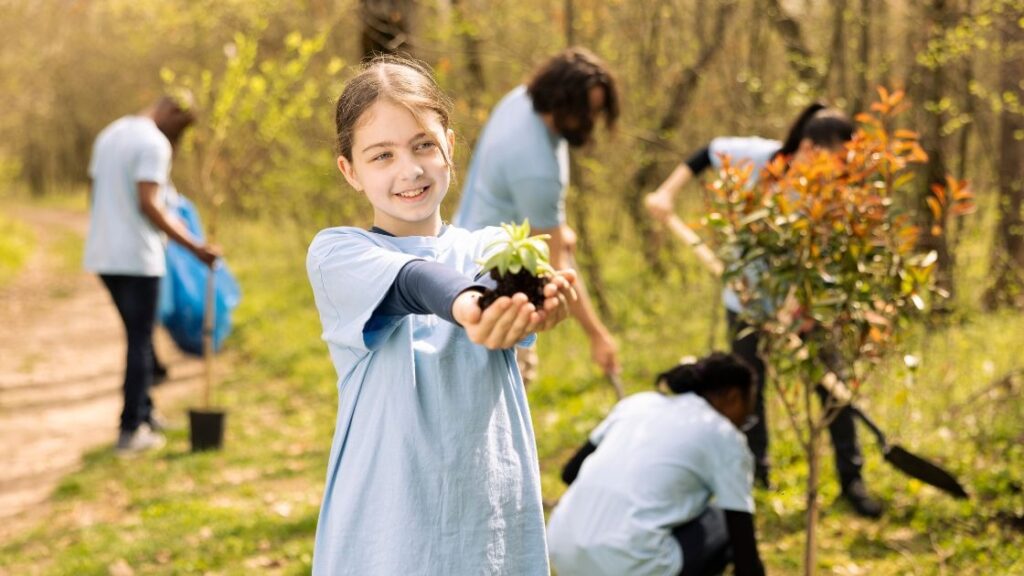
School gardens, nature trail cleanups, bird monitoring projects, and stream water quality testing connect abstract ideas to physical, sensory experience. Students who plant trees or observe seasonal wildlife patterns develop emotional bonds with nature that no lecture can replicate.
Citizen Science Programs
Initiatives like NASA’s Globe Observer enable students to collect real environmental data, from cloud observations to land cover measurements, that researchers use in published studies. Participation transforms learners from passive consumers of science into active contributors.
Student Led Green Initiatives That Make a Difference
Some of the most effective environmental campaigns in recent years have originated with young people themselves. A study published in Social Indicators Research, surveying 1,975 high school students, confirmed that youth are increasingly willing to adopt sustainable habits and push for systemic ecological action.
Eco Clubs and Green Committees
Student run groups can organize awareness weeks, manage tree planting drives, and lobby school boards for greener policies like eliminating single use plastics in dining areas.
Campus Energy Audits
Students can walk through classrooms and hallways to document energy waste, from lights left on in empty rooms to devices drawing phantom power, and present data backed recommendations to administrators.
Social Media Campaigns
Young people are natural digital communicators. Encouraging them to produce short videos, infographics, or blog posts about local environmental challenges spreads their message far beyond school walls.
Community Partnerships
Working alongside local NGOs, parks departments, or agricultural cooperatives exposes students to professional sustainability work. According to a 2026 UNEP report, programs like the Tide Turners Plastic Challenge have reached more than 800,000 young people worldwide through grassroots networks, demonstrating how quickly student action can scale with the right institutional support.
How Parents and Communities Can Support Environmental Learning
Environmental awareness does not stop at the school gate. Families and neighborhoods play a reinforcing role that determines whether green habits stick.
Parents can model sustainable behavior at home by conserving water, composting food scraps, choosing reusable products, and discussing environmental news during meals. Community libraries can host eco themed reading events, and local governments can create youth environmental leadership awards or fund student green projects.
When learners receive consistent messaging at home, in school, and across their community, environmental responsibility becomes part of their identity rather than a topic they study only for exams.
Conclusion
Environmental awareness for students is not an optional extra. It is a core requirement for preparing young people to live, work, and lead in a world shaped by climate disruption, resource limits, and ecological interdependence.
The evidence is clear. Nearly half of all national curricula still overlook climate education, yet 80% of people worldwide want schools to teach it. The green economy is growing, with over 16.6 million jobs already in the renewable energy sector alone. Students who build ecological literacy now will be better prepared as citizens, professionals, and community members.
Every strategy in this guide, from cross curricular teaching and outdoor learning to student led audits and community partnerships, is practical and scalable. The key is to start. Pick one idea, put it into practice this week, and share this article with a fellow educator, parent, or student who wants to make a difference. The planet does not need perfection from any single person. It needs consistent action from all of us.
What is environmental awareness for students?
Environmental awareness for students is the ability to recognize ecological challenges such as pollution, habitat loss, and climate change, and to understand how personal and collective choices influence those outcomes. It blends scientific knowledge with practical skills that shape responsible behavior both in and out of school.
Why is environmental education important in schools?
Schools are where young people build their foundational knowledge and values. Environmental education develops critical thinking, scientific literacy, and civic responsibility while also preparing students for the fast growing green job market. Without it, learners graduate without the tools to understand or address the biggest challenges of their generation.
How can teachers promote environmental awareness in the classroom?
Teachers can weave ecological topics into every subject, use project based learning tied to real local issues, and bring in guest speakers from environmental organizations. Outdoor activities like school gardens, water testing, and nature walks make lessons experiential and memorable.
What are some easy environmental activities for students?
Starting a classroom recycling or composting station, conducting a school energy audit, joining a citizen science app like iNaturalist, organizing a tree planting day, or creating social media posts about local environmental issues are all low cost, high impact activities. Even switching off lights and reducing paper use builds lasting habits.
How do I write an environmental awareness essay?
Begin with a clear thesis that states your position or focus area, such as plastic pollution, deforestation, or water scarcity. Use credible data from organizations like UNESCO, UNDP, or the IPCC to support your arguments. Structure your essay with an introduction, body paragraphs that each address one subtopic, and a conclusion with a call to action. Avoid vague generalizations and ground every claim in evidence.
At what age should environmental education begin?
Environmental learning can start as early as preschool with hands on activities like caring for classroom plants, sorting recyclables, and observing weather. As children grow, topics should expand to cover climate science, biodiversity, energy systems, and environmental policy, building complexity alongside their cognitive development.
How does environmental awareness benefit students in the long term?
Students with strong ecological literacy make more informed choices as consumers, voters, and professionals throughout their lives. They are better positioned to pursue careers in sustainability, contribute to community resilience, and champion policies that protect both public health and natural ecosystems.