
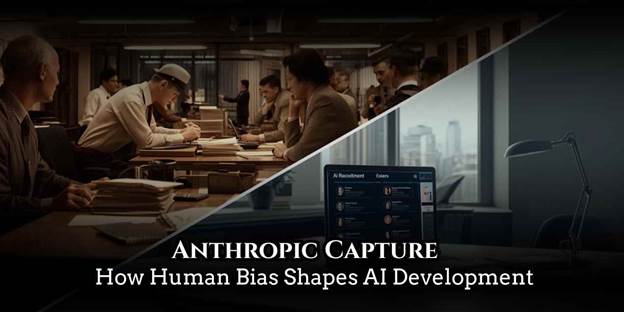
Anthropic capture occurs when human biases, values, and perspectives become embedded within AI models, influencing how these systems interpret data and make decisions. Artificial intelligence systems don’t emerge in a vacuum they’re shaped by the people who create them. As machine learning algorithms increasingly guide critical choices in healthcare, finance, and public policy, understanding this phenomenon becomes essential. This phenomenon reveals why AI bias remains a persistent challenge despite technological advances.
Throughout this article, we’ll explore how cognitive biases infiltrate algorithm design, examine real-world examples of biased AI decision-making, and discuss strategies developers can implement to create more equitable systems. By recognizing anthropic capture in AI development, we can work toward building technology that serves diverse populations fairly and effectively, rather than perpetuating existing societal inequalities through automated systems.
What Is Anthropic Capture in AI Systems?
Anthropic capture refers to the phenomenon where human biases, cultural assumptions, and subjective perspectives become systematically embedded within artificial intelligence systems during their development and training. This occurs because AI models learn from data created by humans, follow objectives defined by human developers, and operate within frameworks designed by people who carry their own cognitive biases and worldviews.
Related Article: Virtual Life: Redefining Human Interaction in the Digital Age
Unlike technical bugs that can be easily identified and fixed, anthropic capture represents a deeper challenge. It manifests when AI systems inherit the blind spots, prejudices, and limited perspectives of their creators. These biases can affect everything from facial recognition accuracy across different ethnicities to hiring algorithms that favor certain demographic groups over others.
How Human Bias Enters AI Development
The Data Collection Stage
The foundation of machine learning begins with training data, and this is where anthropic capture often takes root. When developers collect datasets to teach AI systems, they make countless decisions that reflect their own perspectives:
Selection bias occurs through:
- Choosing which data sources to include or exclude
- Determining what constitutes “representative” samples
- Deciding which historical patterns are relevant for future predictions
- Overlooking minority groups or edge cases in dataset composition
For example, if facial recognition training data predominantly features lighter-skinned individuals, the resulting AI bias will cause the system to perform poorly on darker-skinned faces.
The Algorithm Design Process
Developers make critical choices when designing algorithms that inherently carry human values. Anthropic capture emerges when engineers prioritize certain outcomes over others, often unconsciously reflecting their own cultural context and experiences.
Key decision points include:
- Defining what “success” means for the model
- Choosing which variables to weight more heavily
- Determining acceptable error rates and trade-offs
- Establishing fairness criteria and evaluation metrics
These choices aren’t purely mathematical but involve subjective judgments about what matters most.
Real-World Examples of Anthropic Capture
Hiring and Recruitment Systems
Several major technology companies have faced criticism for biased AI decision-making in their recruitment tools. One notable case involved an algorithm that systematically downgraded resumes from women because it learned from historical hiring patterns that favored male candidates. This example perfectly illustrates anthropic capture perpetuating existing workplace inequalities through automation.
Criminal Justice Algorithms
Risk assessment tools used in courtrooms have demonstrated significant anthropic capture issues. Studies revealed these systems disproportionately classified minority defendants as high-risk compared to their actual recidivism rates, while showing the opposite pattern for white defendants. The algorithms inherited societal biases present in historical criminal justice data.
Healthcare Diagnostic Tools
Medical AI systems trained primarily on data from specific populations often perform poorly when applied to different demographic groups. This represents anthropic capture affecting life-or-death decisions, as diagnostic accuracy varies significantly based on the patient’s race, gender, or geographic origin.

The Challenge of Mitigating Anthropic Capture
Addressing this issue requires more than technical solutions. Organizations must recognize that complete neutrality is impossible, as every design choice reflects human values and priorities.
Primary challenges include:
- Identifying biases that seem “natural” to developers
- Balancing competing fairness definitions across different groups
- Obtaining truly representative training datasets
- Measuring algorithmic fairness across multiple dimensions simultaneously
Furthermore, anthropic capture can be subtle and difficult to detect without diverse testing and evaluation processes.
Strategies for Reducing Human Bias in AI
Building Diverse Development Teams
Teams with varied backgrounds, experiences, and perspectives are better equipped to identify potential sources of cognitive bias before they become embedded in AI systems. Diversity in age, ethnicity, gender, geography, and professional background helps challenge assumptions that might otherwise go unquestioned.
Implementing Rigorous Testing Protocols
Organizations should test AI systems across multiple demographic groups and edge cases before deployment. This includes examining how algorithm design choices affect different populations and actively seeking out potential instances of biased AI decision-making.
Establishing Ethical Oversight
Independent ethics boards and regular audits can help identify anthropic capture that internal teams might overlook. External review provides fresh perspectives on potential bias issues and holds organizations accountable for their AI systems’ real-world impacts.
Conclusion
Anthropic capture remains one of the most significant challenges facing artificial intelligence development today. As we’ve explored, human bias inevitably shapes AI systems through data collection, algorithm design, and decision-making frameworks. Recognizing this phenomenon is the first step toward building more equitable technology. While complete neutrality may be impossible, diverse development teams, rigorous testing protocols, and ethical oversight can significantly reduce harmful biases. As AI continues to influence critical aspects of our lives, understanding anthropic capture becomes essential for everyone not just developers. Stay informed about AI ethics, question automated decisions that affect you, and advocate for transparency in algorithmic systems that shape our society.




1 Comment
Add Yours →[…] Related Article: Understanding Anthropic Capture: How Human Bias Shapes AI Development and Decision-Making […]