Multimodal machine learning is revolutionizing artificial intelligence by enabling systems to process and integrate multiple data types simultaneously, creating more intelligent and context-aware applications. Imagine an AI system that doesn’t just read text or recognize images it seamlessly combines vision, sound, and language to understand the world like humans do. From virtual assistants that see, hear, and respond naturally to medical diagnostics that analyze patient scans alongside clinical notes, multimodal machine learning is pushing the boundaries of what AI can achieve.
This article explores how deep learning architectures fuse diverse data modalities, the key challenges in cross-modal integration, and real-world applications transforming industries. Whether you’re an AI enthusiast or a professional seeking to understand neural network fusion techniques, you’ll discover how combining vision, text, and audio is shaping the future of intelligent systems.
Understanding Multimodal Machine Learning
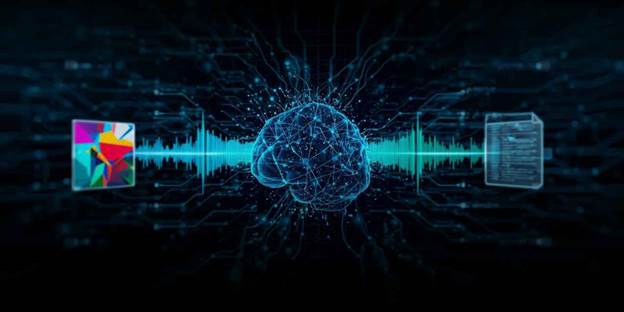
Multimodal machine learning represents a paradigm shift in artificial intelligence, where systems learn from multiple data sources simultaneously rather than relying on a single input type. Unlike traditional machine learning models that process only text, images, or audio independently, multimodal approaches combine these diverse data streams to create richer, more comprehensive understanding.
The concept emerged from the recognition that human perception naturally integrates multiple senses. We don’t just hear words or see images in isolation we combine visual cues, spoken language, and contextual information to make sense of our environment. Multimodal machine learning replicates this capability, enabling AI systems to achieve more human-like comprehension.
Core Components of Multimodal Systems
Effective multimodal machine learning architectures integrate three primary data types:
Vision: Convolutional neural networks process images and videos, extracting visual features like objects, scenes, and spatial relationships.
Text: Natural language processing models analyze written or spoken words, understanding semantics, sentiment, and context.
Audio: Deep learning models process sound waves, recognizing speech patterns, music, environmental sounds, and acoustic features.
How Multimodal Fusion Works
The magic of multimodal machine learning lies in fusion techniques that combine different data modalities. Researchers have developed several fusion strategies:
Early Fusion
This approach combines raw data from multiple sources before processing. For instance, concatenating image pixels with text embeddings creates a unified input vector that neural networks can process simultaneously.
Late Fusion
Individual models process each modality separately, then their outputs merge at the decision stage. This method allows specialized architectures to handle each data type optimally before integration.
Hybrid Fusion
Advanced multimodal machine learning systems use hybrid approaches, fusing data at multiple network layers. This captures both low-level feature interactions and high-level semantic relationships across modalities.
Key Benefits and Applications
Multimodal machine learning delivers significant advantages across various domains:
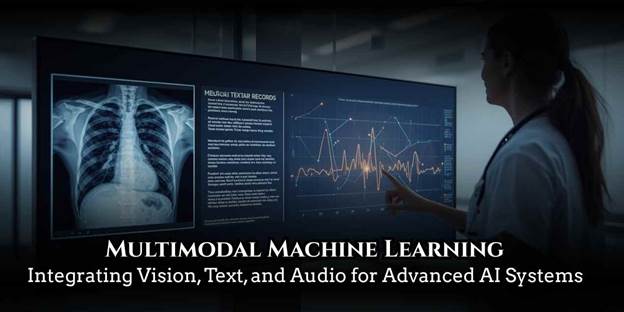
Enhanced Accuracy: Combining multiple data sources reduces ambiguity and improves prediction reliability. A medical diagnosis system analyzing both X-ray images and patient history achieves higher accuracy than using either alone.
Robust Performance: When one modality provides poor quality data, other modalities compensate. Video analysis systems continue functioning even when audio is noisy or lighting conditions are poor.
Richer Context Understanding: Cross-modal learning enables AI systems to grasp nuanced meanings that single-modality approaches miss entirely.
Real-World Applications
Healthcare: Multimodal machine learning combines medical imaging, electronic health records, and genomic data for personalized treatment recommendations and early disease detection.
Autonomous Vehicles: Self-driving cars integrate camera feeds, LiDAR sensors, and GPS data to navigate safely through complex environments.
Content Moderation: Social media platforms use multimodal models to analyze images, text, and video simultaneously, detecting harmful content more effectively.
Virtual Assistants: Modern AI assistants process voice commands, screen context, and user behavior patterns to provide more relevant responses.
Challenges in Multimodal Integration
Despite its promise, multimodal machine learning faces several technical hurdles:
Data Alignment Issues
Synchronizing data from different sources proves challenging. Audio and video must align temporally, while text and images require semantic matching. Misalignment degrades model performance significantly.
Modality Imbalance
Some data types dominate learning, causing models to ignore weaker modalities. Balancing contributions from vision, text, and audio requires careful architecture design and training strategies.
Computational Complexity
Processing multiple data streams simultaneously demands substantial computational resources. Multimodal machine learning models often require powerful GPUs and extensive training time, limiting accessibility for smaller organizations.
Limited Datasets
Training effective multimodal systems requires large datasets with properly aligned, annotated data across all modalities. Such datasets remain scarce compared to single-modality alternatives.
The Future of Multimodal AI
As deep learning architectures evolve, multimodal machine learning continues advancing rapidly. Transformer-based models like CLIP and GPT-4 demonstrate impressive cross-modal understanding, bridging the gap between different data types seamlessly. Research focuses on developing more efficient fusion mechanisms, creating better benchmark datasets, and building models that generalize across diverse multimodal tasks. The integration of vision, text, and audio represents not just a technical achievement but a fundamental step toward artificial general intelligence that perceives and understands the world holistically.
Conclusion
Multimodal machine learning is transforming how AI systems perceive and interact with the world by seamlessly integrating vision, text, and audio data. From healthcare diagnostics to autonomous vehicles, this technology delivers enhanced accuracy, robust performance, and deeper contextual understanding. While challenges like data alignment and computational complexity remain, ongoing advances in deep learning architectures continue pushing boundaries. As multimodal machine learning evolves, it brings us closer to truly intelligent systems that understand the world as humans do. Stay updated with emerging fusion techniques and explore how these powerful AI models can revolutionize your industry or research area.