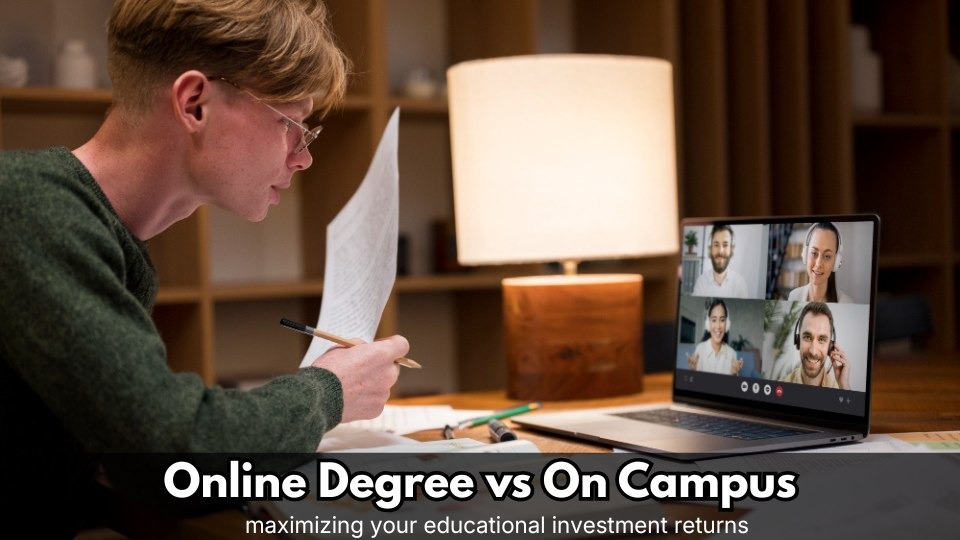
Choosing between online degree vs on campus education represents one of the most consequential decisions affecting your career trajectory and financial future permanently. That learning format selection? It influences outcomes far beyond graduation day.
Here is what decades of academic research actually demonstrates.
Modern students face unprecedented options as digital transformation reshapes higher education landscapes globally. Online degree vs on campus debates have intensified as prestigious universities now offer both formats with identical credential recognition increasingly.
This comprehensive guide presents longitudinal research findings from certified educational consultants who analyze student outcomes across learning modalities professionally. You will discover how distance learning compares with traditional education, and which academic format produces superior results.
We will explore flexible learning benefits, examine campus experience advantages, and reveal career outcome differences between graduates from each pathway. Understanding online degree vs on campus distinctions empowers informed enrollment decisions maximizing your educational investment returns.
The Evolution of Higher Education Delivery Methods
Higher education has transformed dramatically from exclusive physical institutions to diverse learning ecosystems offering multiple pathway options. Traditional universities dominated knowledge transmission for centuries requiring students to relocate and attend classes physically. Online degree vs on campus debates emerged only recently as technology enabled quality distance learning alternatives.
The internet revolution democratized educational access allowing students worldwide to pursue credentials from prestigious institutions remotely. Early online programs faced skepticism regarding quality and employer acceptance compared to traditional education formats. Technological advancements have progressively eliminated quality gaps between delivery methods substantially.
Pandemic disruptions accelerated digital learning adoption forcing even skeptical institutions to develop robust online offerings rapidly. Students and employers alike gained exposure to virtual education demonstrating its viability for serious academic pursuits. Online degree vs on campus comparisons now involve increasingly equivalent options rather than clearly inferior alternatives.
Academic Quality and Learning Outcomes Analysis
Research comparing learning outcomes between formats reveals surprisingly minimal differences when programs maintain equivalent rigor standards. Students in well designed distance learning programs demonstrate comparable knowledge acquisition to traditional classroom counterparts consistently. Academic format matters less than instructional quality and student engagement levels.
Accreditation standards apply equally to online and campus programs ensuring baseline quality regardless of delivery method. Prestigious universities offering both formats maintain identical curriculum requirements and faculty qualifications across modalities. Online degree vs on campus quality differences depend on specific institution and program rather than format inherently.
Assessment methods have evolved enabling rigorous evaluation of online student learning through proctored examinations and project submissions. Concerns about academic integrity in virtual environments have been addressed through sophisticated verification technologies. Learning outcomes research supports format equivalence when quality controls remain consistent.
Employer Perception and Credential Recognition
Hiring manager attitudes toward online credentials have shifted dramatically as digital education mainstreamed across industries. Research indicates most employers now consider online degrees equivalent to traditional education credentials for hiring decisions. Online degree vs on campus distinctions matter less to recruiters than program accreditation and candidate capabilities demonstrated.
Industry specific variations persist with some traditional sectors maintaining preferences for campus educated candidates. However, technology, business, and healthcare fields increasingly accept online credentials without discrimination. Employer perception continues evolving favorably toward flexible learning graduates.
Completion Rates and Student Success Metrics
Online programs historically demonstrated lower completion rates compared to traditional campus based education formats. Self discipline requirements and isolation challenges contributed to higher dropout rates among distance learners initially. Improved student support services have narrowed these completion gaps considerably recently.
Structured online programs with regular interaction requirements now achieve comparable completion rates to traditional education alternatives. Student success depends more on individual characteristics and program design than delivery format alone. Online degree vs on campus completion differences reflect program quality variations rather than inherent format limitations.
Flexibility and Accessibility Advantages
Distance learning enables working professionals to pursue credentials without abandoning careers or relocating families disruptively. This flexibility represents the primary advantage driving online enrollment growth globally continuously. Traditional education demands schedule accommodations that many adult learners simply cannot make practically.
Geographic barriers disappear when students access programs remotely from any location with internet connectivity reliably. Rural residents and international students gain access to institutions previously requiring expensive relocation permanently. Online degree vs on campus accessibility differences create opportunities for previously excluded populations significantly.
Consider these flexibility benefits that certified educational consultants identify as driving online enrollment decisions:
- Ability to maintain full time employment while pursuing advanced credentials simultaneously
- Elimination of commuting time and associated transportation costs throughout program duration
- Self paced learning options allowing acceleration or deceleration based on life circumstances
- Access to specialized programs unavailable locally without requiring permanent relocation
- Reduced overall educational costs through eliminated housing and transportation expenses substantially
Campus Experience and Networking Benefits
Traditional education provides immersive experiences developing social skills and professional networks impossible to replicate virtually completely. Campus environments foster spontaneous interactions, collaborative learning, and mentorship relationships organically. Online degree vs on campus networking differences represent significant considerations for career focused students.
Extracurricular activities including clubs, sports, and organizations build leadership capabilities and teamwork experience employers value highly. These developmental opportunities remain limited in virtual learning environments despite technological improvements. Traditional education delivers holistic development beyond academic credential acquisition alone.

Face to Face Interaction Value
In person instruction enables immediate feedback, spontaneous discussion, and non verbal communication enhancing learning experiences substantially. Students benefit from observing peer contributions and professor reactions during live classroom interactions directly. Campus experience advantages include these irreplaceable interpersonal learning dimensions.
Laboratory sciences, performing arts, and hands-on disciplines require physical presence for skill development. Some fields remain unsuitable for complete online delivery despite technological advancements addressing many limitations. Online degree vs on campus decisions must consider discipline specific requirements carefully.
Alumni Networks and Career Services
Established universities maintain extensive alumni networks providing career opportunities and professional connections for graduates continuously. Campus based students typically develop stronger institutional affiliations supporting network engagement long term. Flexible learning graduates may access these resources but often with reduced connection intensity.
Career services including interview preparation, resume development, and employer introductions support campus students more comprehensively traditionally. Virtual career support has improved but rarely matches comprehensive campus offerings equivalently. Online degree vs on campus career support differences warrant consideration during program selection processes.
Making Your Informed Decision
Individual circumstances determine which format optimizes educational outcomes rather than universal superiority of either approach. Career stage, learning preferences, financial constraints, and family obligations all influence ideal format selection significantly. Online vs on campus choices require honest self assessment regarding personal needs and capabilities.
Hybrid programs combining online flexibility with periodic campus intensives offer compromise solutions for many students effectively. These blended approaches capture benefits from both formats while minimizing respective limitations substantially. Educational innovation continues creating new options beyond traditional binary choices.
Conclusion:
Selecting your ideal educational pathway requires careful evaluation of personal circumstances, career goals, and learning preferences honestly. Throughout this guide, certified educational consultants have shared longitudinal research findings demonstrating how distance learning and traditional education produce comparable outcomes when program quality remains consistent.
The online degree vs on campus debate reveals that neither format holds universal superiority over the other. Flexible learning benefits working professionals while campus experience advantages support networking and holistic development uniquely.
Start evaluating your options strategically today. Whether prioritizing accessibility, seeking immersive experiences, or considering hybrid approaches, every informed decision matters significantly. Understanding it distinctions empowers enrollment choices maximizing your educational investment and professional success.