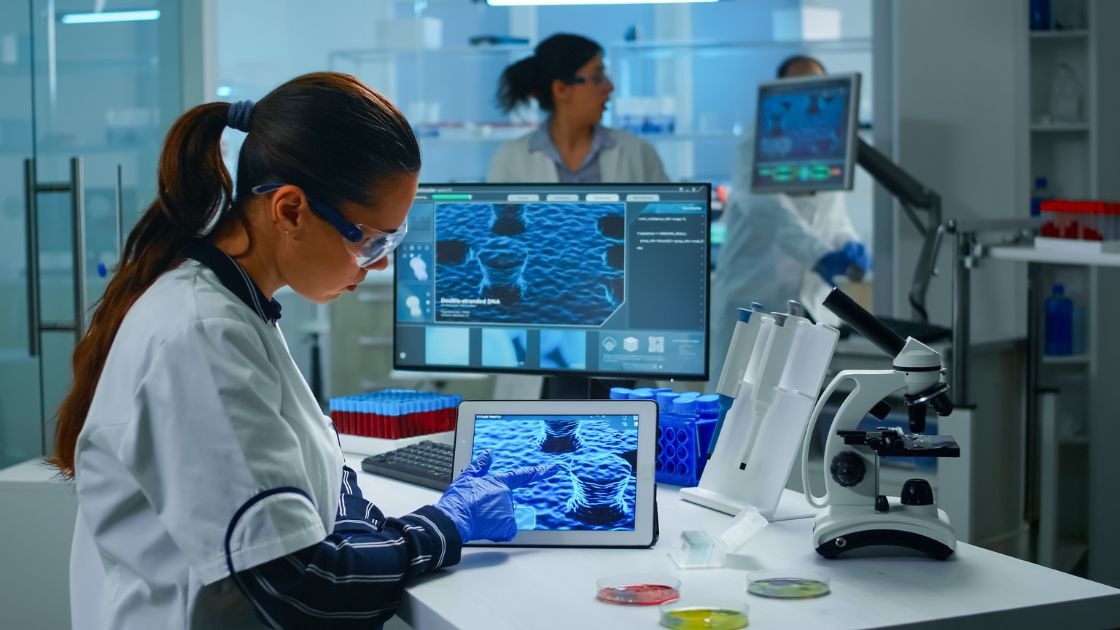
Deep learning in bioinformatics is the application of multilayered neural networks to analyze, interpret, and uncover patterns within large scale biological datasets. It operates at the intersection of artificial intelligence, computational biology, and data science, giving researchers the ability to solve problems that traditional statistical approaches could never handle.
What sets deep learning apart from classical machine learning is automated feature extraction. Rather than relying on domain experts to hand select input variables, deep learning models learn representations directly from raw data. This capability makes them uniquely suited for high dimensional biological inputs such as genomic sequences, three dimensional protein structures, and single cell transcriptomic profiles.
According to a 2025 survey published in Briefings in Bioinformatics by Jiang et al. at Oxford Academic, AI techniques are now extensively applied to DNA, RNA, and protein sequence prediction and design, 3D structural elucidation, functional annotation, integrative analysis of multi omics data, and personalized drug design for precision medicine. (Read the full survey)
Table of Contents
Why Deep Learning Matters for Modern Bioinformatics
The single biggest driver behind deep learning’s rise in bioinformatics is the sheer explosion of biological data. The widespread adoption of high throughput sequencing technologies and multi omics approaches has led to rapid accumulation of genomic, transcriptomic, proteomic, and even single cell multimodal datasets, creating an unprecedented demand for intelligent computational tools.
Traditional analytical pipelines cannot keep up with this volume. Deep learning fills this gap through three core strengths:
Scalability: Neural networks process billions of data points across entire genomes without manual intervention, making them ideal for population scale studies and biobank level analyses.
Accuracy: Architectures like transformers and convolutional neural networks (CNNs) consistently outperform older methods in critical tasks such as variant calling, protein folding prediction, and cancer biomarker detection.
Adaptability: A single deep learning framework can be fine tuned for genomics, proteomics, drug design, or medical imaging, serving as a versatile engine across the full bioinformatics pipeline.
The economic impact is equally striking. According to Fortune Business Insights, the global bioinformatics market was valued at approximately USD 31.74 billion in 2025 and is projected to grow to USD 118.25 billion by 2034 at a compound annual growth rate of 15.08%. (View the report) AI and deep learning integration are among the primary growth catalysts.
Key Applications of Deep Learning in Bioinformatics
Deep learning is reshaping nearly every subdomain of biological research. Below are the applications with the greatest impact today.
Protein Structure Prediction
Predicting how a protein folds into its three dimensional shape remained one of biology’s grand challenges for more than five decades. Deep learning solved it.
DeepMind’s AlphaFold 2 achieved a median domain GDT score of 92.4 in the CASP14 competition, the first time this level of accuracy had ever been reached, and it represented a significant improvement over all prior methods. (Read the study on PubMed)
The AlphaFold Protein Structure Database now provides open access to over 200 million predicted protein structures, serving more than 3 million researchers in over 190 countries. (Explore the database)
AlphaFold 3, announced in May 2024, can predict the joint structure of complexes including proteins, nucleic acids, small molecules, ions, and modified residues, demonstrating substantially improved accuracy over many previous specialized tools. (Read in Nature)
Genomics, Variant Calling, and Sequence Analysis
Convolutional neural networks and recurrent neural networks are now standard tools for identifying regulatory elements, predicting gene expression, and detecting disease linked mutations.
A comprehensive 2025 survey in Briefings in Bioinformatics reported that deep learning models now achieve sensitive cancer detection with an AUC of approximately 0.93, robust single cell modeling with average biological scores around 0.82, and protein design success rates up to 92%. (View on PMC)
Google’s DeepVariant, a deep learning based variant caller, transforms the problem of identifying genetic variants into an image classification task using convolutional neural networks applied to pileup image tensors from aligned reads. (GitHub repository) It won the highest SNP accuracy award at the PrecisionFDA Truth Challenge and has since reduced its error rate by more than 50%. (Google Research blog)
Transformer based biological language models, including BioBERT and DNABERT, treat biological sequences much like human language, learning contextual relationships between nucleotides or amino acids to power highly accurate predictions across genomics tasks.
Single Cell RNA Sequencing Analysis
Deep learning has emerged as a particularly promising tool for single cell RNA seq data analysis because it can extract informative and compact features from noisy, heterogeneous, and high dimensional scRNA seq data to improve downstream analysis, according to a review published in Genomics, Proteomics & Bioinformatics. (Read on ScienceDirect)
Tools like scVI (single cell variational inference) and scGNN (single cell graph neural network) use deep generative models and graph neural networks respectively to handle cell clustering, imputation of missing values, trajectory inference, and batch effect correction at scale.
Drug Discovery and Molecular Design
The pharmaceutical industry has rapidly adopted neural networks for target identification, binding affinity prediction, and de novo molecule generation.
A 2025 study published in Frontiers in Bioinformatics found that deep learning methods have significantly advanced binding affinity prediction for G protein coupled receptors (GPCRs), one of the most pharmacologically important protein families, with newer models incorporating attention mechanisms and self supervised learning. (Read the paper)
A 2025 paper in the Journal of Big Data (Springer) presented a hybrid deep learning framework using variational autoencoders within a microservices architecture, designed to generate novel drug candidates while enabling scalable, modular bioinformatics workflows. (Read on Springer)
Deep Learning Architectures Used in Bioinformatics
Choosing the right neural network architecture depends on the biological problem. Here is a comparison of the six most widely used model types:
| Architecture | Best Suited For | Example Application |
| Convolutional Neural Networks (CNNs) | Pattern recognition in sequences and images | DNA motif detection, histopathology imaging, variant calling via DeepVariant |
| Recurrent Neural Networks (RNNs/LSTMs) | Sequential and time series data | Gene expression dynamics, RNA secondary structure prediction |
| Transformers | Contextual sequence modeling | Protein language models (ESM, BioBERT, DNABERT) |
| Variational Autoencoders (VAEs) | Generative modeling and data compression | Novel molecule design, single cell data denoising (scVI) |
| Graph Neural Networks (GNNs) | Molecular and relational data | Protein protein interaction networks, single cell analysis (scGNN) |
| Generative Adversarial Networks (GANs) | Data augmentation and synthesis | Synthetic genomic data generation, data balancing |
Researchers frequently combine multiple architectures into hybrid models to address the multidimensional complexity of biological datasets.
Real World Tools and Frameworks Worth Knowing
Beyond theoretical models, several open source tools have brought deep learning in bioinformatics into practical research settings:
AlphaFold / AlphaFold 3: Protein structure prediction at near experimental accuracy, freely accessible through the AlphaFold Protein Structure Database.
DeepVariant: Google’s CNN based variant caller for next generation sequencing data, available on GitHub.
scVI Tools (scverse ecosystem): A suite of deep generative models for single cell omics, covering tasks from data integration to differential expression.
DeepChem: An open source library for drug discovery, materials science, and quantum chemistry built on top of TensorFlow and PyTorch.
Scanpy: A scalable Python toolkit for analyzing single cell gene expression data, widely used alongside deep learning based preprocessing tools like CellBender.
TensorFlow and PyTorch: The two foundational deep learning frameworks that power the majority of bioinformatics neural network research.
Challenges and Limitations of Deep Learning in Bioinformatics
Despite transformative results, deep learning in biological research faces real obstacles that demand attention.
Data Quality and Availability
Obtaining large scale datasets in bioinformatics is particularly challenging due to the cost and time involved in experimental data generation, limited availability of well annotated data, and the inherent complexity of biological systems. (Read on PMC)
Imbalanced datasets compound this problem. When training a model to detect rare mutations, normal sequences overwhelmingly dominate. This skew can cause models to favor the majority class, missing the very signals they were designed to catch.
The Interpretability Problem
Deep learning predictions are often treated as black boxes because the knowledge representation within the model is not explicit, making it difficult to understand the biological basis behind specific outputs. A clinician diagnosing a genetic disorder needs to understand why a model flagged a particular region, not simply that it did.
Explainable AI methods like SHAP values, attention map visualization, and gradient based attribution are gaining adoption, but they remain imperfect. Achieving true biological interpretability in neural networks is still an active research frontier.
Computational Cost and Accessibility
Deployment of deep learning in bioinformatics is often hindered by computational intensity, lack of scalability, and limited interoperability with existing bioinformatics platforms, as noted in a 2025 study in the Journal of Big Data. For smaller laboratories and institutions in resource limited settings, access to high performance GPUs and cloud infrastructure remains a genuine barrier.
Ethical and Privacy Concerns
A 2025 review in Oxford Academic identified ethical and privacy concerns as a persistent challenge in AI driven bioinformatics, alongside issues of data noise, sparsity, and insufficient model interpretability. Human genomic data is deeply personal, and ensuring patient privacy while enabling collaborative research requires robust governance frameworks and techniques such as federated learning.
Emerging Trends Shaping the Future
The field is moving fast. Several trends are poised to reshape deep learning in computational biology over the next few years.
Foundation Models for Biology
Just as GPT style models transformed natural language processing, biological foundation models are beginning to redefine bioinformatics. Models like ESM (Evolutionary Scale Modeling) from Meta AI and AlphaFold 3 from Google DeepMind are trained on vast biological datasets and can be fine tuned for diverse downstream tasks, from protein engineering to drug response prediction.
A 2025 survey in Briefings in Bioinformatics emphasized that the combination of traditional machine learning with deep learning, reinforcement learning, and large scale foundation models is rapidly propelling innovation across genomics, protein engineering, and precision medicine. (Read on PMC)
Multi Omics Data Integration
Researchers are combining genomic, transcriptomic, proteomic, and metabolomic datasets into unified deep learning pipelines. This multi omics approach provides a holistic view of biological systems, moving beyond single data types. However, challenges persist, particularly around data noise, sparsity, difficulties in modeling long biological sequences, and the complexity of multimodal data integration.
Transfer Learning and Few Shot Learning
Transfer learning enables researchers to adapt a model pretrained on a large general dataset for a smaller, specialized task. This is critical in bioinformatics, where labeled training data for specific diseases or rare organisms is often scarce. Few shot learning pushes this further, allowing models to generalize meaningfully from just a handful of labeled examples.
Cloud Based and Democratized Access
Cloud platforms from Google Cloud, AWS, and Microsoft Azure are making high performance bioinformatics workflows accessible to labs that lack on premise GPU clusters. Tools like AlphaFold Server and Terra (by the Broad Institute) allow researchers worldwide to run deep learning analyses without owning specialized hardware.
Topical Range: Where Deep Learning Meets Other Disciplines
Deep learning in bioinformatics connects to a wide range of neighboring fields, strengthening its topical authority and practical reach:
Precision Medicine: Neural networks analyze individual genomic profiles alongside clinical records to identify patient specific treatment pathways, enabling tailored therapies for cancer, rare diseases, and pharmacogenomics.
Agricultural Genomics: Deep learning models are being deployed to improve crop resilience, predict pest resistance, and optimize breeding programs by analyzing plant genomes at population scale.
Environmental Biology: Researchers use these methods to study microbial ecosystems, track biodiversity through environmental DNA (eDNA) sequencing, and model ecological dynamics under climate change scenarios.
Clinical Diagnostics: From automated cancer detection in histopathology images to flagging rare genetic disorders in newborn screening panels, deep learning tools are entering clinical workflows across the globe.
Structural Biology: Beyond AlphaFold, deep learning is accelerating cryo electron microscopy (cryo EM) image reconstruction and X ray crystallography structure determination, complementing experimental techniques rather than replacing them.
How to Get Started with Deep Learning in Bioinformatics
If you are a researcher, data scientist, or student looking to enter this field, here are practical first steps:
Learn Python thoroughly. Python is the dominant language in both deep learning and bioinformatics. Libraries like TensorFlow, PyTorch, Scanpy, and Biopython form the core toolkit.
Explore public biological datasets. Resources like NCBI’s Gene Expression Omnibus (GEO), the Protein Data Bank (PDB), and the ENCODE Project offer freely available, well annotated data for practice and experimentation.
Start with existing tools. Run AlphaFold predictions using its free Colab notebook. Try DeepVariant on sample sequencing data. Experiment with scVI for single cell analysis. Hands on experience with established tools builds intuition faster than theory alone.
Study foundational papers. Read the original AlphaFold 2 paper in Nature, the DeepVariant publication in Nature Biotechnology, and review articles in Briefings in Bioinformatics to understand where the field stands and where it is heading.
Conclusion
Deep learning has fundamentally reshaped how biological data is analyzed, interpreted, and applied. From cracking the 50 year old protein folding problem through AlphaFold to enabling real time variant calling with DeepVariant and powering single cell analysis at million cell scale, neural networks have become indispensable to modern bioinformatics.
The challenges are real. Data quality, model interpretability, computational cost, and ethical concerns around genomic privacy all require continued attention. But the trajectory is unmistakable. As foundation models mature, multi omics integration deepens, and cloud access democratizes high performance computing, the next generation of breakthroughs in deep learning for bioinformatics is already taking shape.
Whether you are a computational biologist building new models, a bench scientist looking to integrate AI into your workflow, or a student choosing a career path, now is the ideal time to engage with this rapidly evolving field. Explore the open source tools mentioned above, dive into the published literature, and consider how deep learning could accelerate your own research goals.
Have thoughts on the future of AI in biological research? Share this article with your network or leave a comment below to join the conversation.
What is deep learning in bioinformatics used for?
Deep learning in bioinformatics is used to predict protein structures, analyze genomic sequences, identify drug targets, diagnose diseases from molecular data, and integrate multi omics datasets. It automates feature extraction from raw biological inputs and frequently outperforms traditional machine learning in both accuracy and scalability.
How did AlphaFold change the field of bioinformatics?
AlphaFold, built by Google DeepMind, solved the protein structure prediction challenge by achieving near experimental accuracy at the CASP14 competition. Its freely accessible database of over 200 million predicted structures has been used by millions of researchers globally, dramatically cutting the time and cost of structural biology research.
What is the difference between machine learning and deep learning in bioinformatics?
Machine learning in bioinformatics relies on algorithms that require manually engineered features as inputs, while deep learning uses multilayered neural networks that learn features automatically from raw data. Deep learning is better suited for large, complex, and unstructured biological datasets, whereas classical machine learning remains effective for smaller, well defined problems.
What are the biggest challenges of applying deep learning in bioinformatics?
The primary challenges include limited availability of high quality labeled datasets, the black box nature of neural network predictions that hinders clinical trust, high computational resource requirements for training large models, and ethical concerns around genomic data privacy and patient consent.
Which Python libraries are commonly used for deep learning in bioinformatics?
The most widely used libraries include TensorFlow and PyTorch for building and training neural networks, Scanpy and scVI for single cell analysis, Biopython for general bioinformatics tasks, and DeepChem for drug discovery and molecular modeling workflows.
Is deep learning replacing traditional bioinformatics methods?
Deep learning complements rather than fully replaces traditional methods. Classical statistical tools and algorithms like BLAST, GATK, and hidden Markov models remain valuable for well established tasks and smaller datasets. Deep learning excels when dealing with massive, high dimensional, or unstructured data where manual feature engineering is impractical or insufficient.
What does the future of deep learning in bioinformatics look like?
The future is defined by biological foundation models that can be adapted across tasks, deeper multi omics integration, explainable AI for clinical adoption, and broader cloud based access that democratizes high performance computing for labs worldwide. As datasets grow and computational costs decline, deep learning will become even more central to biomedical discovery and precision medicine.