Voxel hashing is transforming how we perceive and recreate the three-dimensional world in real time. This cutting-edge technique allows computers to efficiently store and process 3D data, making real-time 3D reconstruction faster and more accurate than ever before. From augmented reality (AR) applications to advanced robotic navigation, voxel hashing is pushing the boundaries of what’s possible in digital mapping.
In this article, we’ll explore how this innovative approach works, its core principles, and the remarkable ways it’s shaping industries like gaming, architecture, and virtual environments. By the end, you’ll understand why they stands as a cornerstone in the evolution of 3D technology and spatial computing.

Understanding the Concept of Voxel Hashing
Voxel hashing is an innovative method designed to efficiently manage large-scale 3D data. It divides a 3D environment into small cubic units called voxels, each representing a specific spatial volume. Instead of storing every voxel in memory, they uses a hash table to index and access only those that contain relevant information. This approach makes 3D mapping and real-time reconstruction far more efficient and scalable than traditional methods.
By leveraging spatial data structures and parallel computing, they enables quick updates and rendering of scenes, even on standard hardware. This technique is particularly useful in augmented reality (AR), virtual reality (VR), and robotic perception, where speed and precision are essential.
Historical Background and Development
They originated from the need to overcome the limitations of conventional 3D reconstruction systems. Early 3D mapping methods, such as volumetric integration and truncated signed distance functions (TSDF), required massive amounts of memory and computational power.
In 2013, researchers from Microsoft introduced as a breakthrough technique that could map real-world environments in real time without heavy hardware demands. This innovation opened the door for applications in robotic navigation, medical imaging, and spatial computing.
Evolution of 3D Reconstruction Technologies
- Static 3D Scanning – Early systems captured fixed models but lacked real-time interaction.
- Dynamic Reconstruction – Integration of sensors like RGB-D cameras made live mapping possible.
- Voxel Hashing Revolution – Introduced memory-efficient data handling for real-time scene updates.
Importance of Voxel Hashing in Modern Technology
They plays a pivotal role in enabling devices to understand and interact with their surroundings. It allows systems to represent 3D environments accurately while maintaining speed and performance.
Key Areas of Impact
- Augmented and Virtual Reality (AR/VR): Delivers immersive experiences with realistic environmental mapping.
- Robotics: Helps robots navigate complex terrains using spatial awareness.
- Autonomous Vehicles: Enhances environmental perception for obstacle detection.
- Medical Imaging: Supports precise visualization in 3D tomography and organ reconstruction.
These applications highlight the versatility and revelenve intelligent systems and digital transformation.
Benefits of Voxel Hashing
They offers several unique advantages that make it superior to traditional volumetric approaches.
1. Efficient Memory Usage
Only the active voxels are stored, which drastically reduces memory requirements.
2. High-Speed Computation
Its hash-based indexing allows real-time updates and fast access to voxel data.
3. Scalability
Can handle large-scale scenes without performance degradation, suitable for 3D mapping of entire environments.
4. Flexibility
Works seamlessly with depth sensors, RGB-D cameras, and LiDAR systems, making it adaptable to various technologies.
5. Cost-Effectiveness
Reduces the need for expensive high-performance systems, allowing broader adoption in industries.
Challenges and Limitations
Despite its advantages, and still faces certain challenges that limit its universal adoption.
Computational Complexity
Although efficient, it demands well-optimized algorithms to avoid hash collisions and maintain consistency.
Data Accuracy
Errors in sensor input can lead to incomplete or distorted voxel representations.
Hardware Constraints
Real-time reconstruction still depends on the performance of GPU-based systems and high-quality sensors.
Integration Issues
These with AI-driven reconstruction and other machine learning models can be computationally intensive.
Practical Applications and Examples
Voxel hashing is now a backbone technology in many real-world systems.
Robotics and Autonomous Systems
Robots use voxel hashing to build 3D occupancy maps, which allow them to detect obstacles and plan movement efficiently.
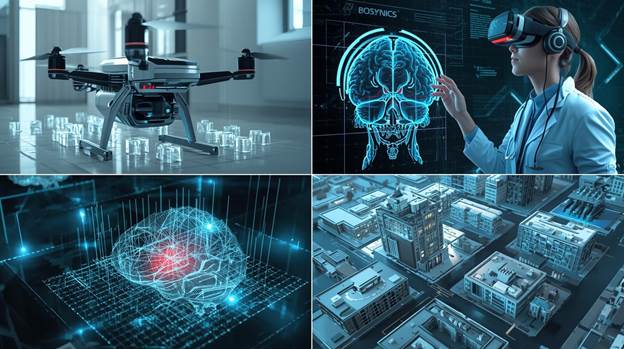
Example: Drones employing they can create real-time 3D maps for indoor navigation.
Medical Imaging and Diagnostics
In medical visualization, they enhances 3D organ reconstruction, allowing better surgical planning and analysis.
Example: MRI data can be processed faster to create accurate 3D models of the human brain.
Gaming and Virtual Reality
Game developers use to render dynamic environments that change according to player interaction.
Example: VR headsets can map user surroundings instantly for safety and immersion.
Smart Cities and Architecture
Architects and urban planners rely on 3D spatial reconstruction to design, analyze, and visualize smart infrastructure.
Example: Voxel-based systems are used to simulate city layouts for urban planning and disaster management.
Future Prospects of Voxel Hashing
They looks promising as AI, deep learning, and real-time rendering technologies advance. Integration with neural networks could enable systems to automatically improve mapping accuracy and reduce computational overhead.
Potential Advancements
- Hybrid Models: Combining voxel hashing with neural radiance fields (NeRF) for hyper-realistic 3D rendering.
- Cloud-Based Reconstruction: Storing voxel data on cloud servers for large-scale collaborative mapping.
- Edge Computing Integration: Bringing real-time 3D reconstruction to mobile and IoT devices.
With continued innovation, they will likely remain a key technology for bridging the gap between the physical and digital worlds.
Conclusion
In summary, voxel hashing has transformed the way we capture, store, and interpret three-dimensional spaces in real time. By making 3D mapping and real-time reconstruction faster and more efficient, it has become a cornerstone for advancements in robotics, AR/VR, and digital design. Despite technical challenges, its growing integration with AI and cloud systems promises even greater potential. As innovation continues, exploring voxel hashing further will help researchers, developers, and enthusiasts unlock new dimensions of interactive and intelligent 3D technology.